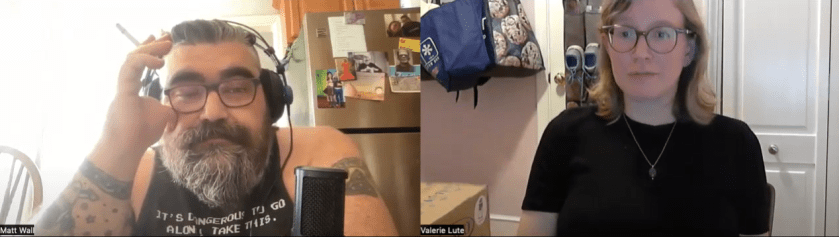
Matt Wall is a punk Renaissance man, working across music, film, poetry, and science fiction. With his do-it-yourself ethos and no-permission-needed approach, Matt embodies the indie spirit. I was inspired by his unique attitude toward creation and publishing, so I asked if he’d share some tips on turning passion into action.
Matt spoke about the raw, unedited nature of his poetry, his goal of expanding his poets’ audiences, and the lessons he learned about releasing fiction on Amazon. Most importantly, he encouraged all you new writers to stop overthinking, start creating, and gave permission to write whatever the hell you want.
Creating Raw Art
You’re a poet and you run a small press, Poetic Anarchy Press. What can you tell a new potential reader about your work, both your own poetry and what your press produces?
I started the press because I couldn’t find stuff I liked to read. I started doing this Poetic Anarchy workshop just in hopes of trying to find people who I liked their shit. And so I was doing the workshops for two years, and then I realized, “Oh shit, there’s a lot of great fucking poets out there.” So I started putting out anthology books on Amazon of the people who came to the workshops. Then I started doing The Blood Rag, which is the one-page broadside, and it just has grown from there. It’s basically very selfish in that the only stuff I put out is stuff that I like to read.
As far as what my stuff is like, it’s really raw snapshot glimpses into things that I’m working through. It’s very therapeutic for me, but I also don’t believe in a lot of editing. I feel like every time you edit you are pulling honesty away from things, and if you do it too much, the soul of the poem disappears, and you just have a bunch of nice-looking lines, but the heart and the blood is gone. I try to do it right the first time.
There is a skill in being in touch with your emotions and having clarity in your thoughts, and even if you’re not editing your poems, the more you do that and try to be clear and express yourself the better the next poem will get.
That’s a good way to look at it. I’ll steal that and use that next time.
I know Charles Bukowski is one of your biggest influences. How has he influenced your writing style? Are there specific poems that you come back to often for inspiration?
Bukowski is a huge influence on me, but I can’t say it would just be him on his own. I do have my own issues with Bukowski. The gonzo observational journalism of Hunter S. Thompson and the cynical satire of Kurt Vonnegut, those things probably are a bigger influence to me than just the poetry of Bukowski. But Bukowski is from here, where I am and he lived on this street where I’m living on now, and he walked these same streets and went to the same shops that I go to every day. So being in the place, walking the walks that other people walked, it makes things more real for me.
As far as a poem goes, he has a poem called “Art.” I’m going to try to say it from memory, and I might fuck this up. “As the spirit wanes, the form appears.” That has always made a huge kick in my balls. If you’re thinking too much about it, your soul isn’t in it. Just think less, write more.
Punk Publishing Ethos
It’s always easier to move a car that’s in drive than it is to move a parked car.
I got interested in chapbooks and zines because I felt like there was a disconnect between my passion for underground music and my literary writing. In the literary world, especially these days, it seems like people value prestige over finding a readership.
Totally, 100%. I don’t know if you’ve heard of SLEERICKETS, but I was on that podcast a while back, and we got into this debate over prestige versus readership or monetary gain. We kept going back and forth on it because the guy who hosts that show, Matthew Buckley Smith, who’s great, but he’s an MFA world guy. He kept talking about how you don’t do anything other than for the prestige. Finally, I’m like, dude, “I can’t fucking pay my rent with prestige, motherfucker. My landlord don’t take it.” He’s great, and we went back and forth, but the idea of prestige to me means less and less because I don’t think most people give a shit. If you were to ask who was the last poet who got a big spread in Poetry, no one would fucking know that except a handful of people who are into that little world, and they probably all know each other anyway. So what the fuck does it matter.
I was wondering, because you started your career in underground music, do you think that influences how you view your poetry and your press?
Yeah, here’s the thing that’s weird. When people say, you have a real punk rock attitude about this, this and that. That’s the only thing I know, so it’s not like I’m like, “I’m going to do this because it’s so fucking punk rock.” It’s just this is how I had to fucking do it. This is how I learned to do things. It has totally shaped everything I do, but it did that out of necessity rather than out of aesthetic purposes.
I feel like a lot of literary presses do things because of tradition, but what you’re doing is very innovative. I watched your video today, “How to start a book publishing company small press.” You talked about how your job as a publisher is to help your poets expand their audience. Do you think that sets you apart from other small presses?
If it does, I think that’s an indictment of what small presses are. If a small press isn’t trying to build the readership of the people they put out, then what the fuck are they doing? I just don’t know what the end game is. I can’t see what the goal would be. It just doesn’t make any sense. If that’s the case, then that’s sad as shit.
I went to a writing conference this year, and I was at a panel about starting a literary journal and [the editors on the panel] were bragging about not knowing how many readers their online journal had.
But what’s the brag? “I’m so aloof and apathetic that I don’t fucking give a shit?” Do they just run on grants? Ok, whatever. All this shit is going to dry up, and I don’t know what the fuck they’re going to do. I keep reading how small presses are folding and lit journals are folding, and how the grant money that was there pre-COVID isn’t there anymore. Motherfuckers are fighting to get less money than there was in the first place. But I don’t think they’re fucking fighting because I don’t know if any of them know how to. I feel like if you put them all in a room and put a hurdle in the middle of the room and a sandwich on the other side, and just said, “OK you guys are all going to starve unless you eat that sandwich,” they’ll just be like, “I’m sure someone will come along and hand it to me. I’m not going to fucking climb that hurdle.”
It’s just like, how do you live? I don’t get it. I don’t want to do the whole “how you were raised” bullshit. It’s just a completely different culture that I do not understand and will probably never be accepted into—that’s fine—and it probably won’t even exist in sixty years.
I appreciate how you have a lot of passion for what you’re doing, and you’re being innovative in how you bring art to people. I have a lot of frustrations with [what’s going on] and I always feel like I should be doing more to come up with my own ideas for getting people to care about the written word.
My question to you I guess would be, what is the thing holding you back from trying to figure that out.
I feel like I am trying, it’s just there’s always more that one could be doing.
We can’t ever be super hard on ourselves because if we do that, we’re not going to ever fucking do anything. I’m just always like, “I’m just going to fucking do something.” It’s always easier to move a car that’s in drive than it is to move a parked car. So I’ll just fucking start something, and it will be little, and see what happens. Too many people who want to do something and want to try to change something feel like they need to have the whole fucking thing planned out before they do anything.
When you’re inspired to do something, that’s when you go. Lightning strikes and it flashes. I encourage you to, the second you have an idea to help that shit, just fucking do it.
How to Kill It on Amazon
You mostly write poetry but you do a little fiction too, right?
Because I was making movies and writing screenplays and shit, and then I had all these movies that I still wanted to do, but I was tired of working for producers. This was right around the time that Kindle took off on Amazon, so like 2011, 2012, and I had a TV show pilot that I turned into a serial. I was releasing weekly episodes. That blew up for me. It was nice not writing to a budget. I could do anything I wanted to do. That was so fucking freeing.
I was releasing on a chaotic schedule for the next three years doing novellas, novels, and more serials in all different kinds of genres. It took me a while to realize that doing stuff like that is poison on Amazon. You have to do the same thing over and over again in order for Amazon to want to push you to people.
That took me all over the place. Probably by 2016, I got back into poetry. That being the thing that got me writing in the first place. I’ve just been doing it ever since because I can do it quickly and I can do any genre stuff I want. I could write about multiple different things in one day and feel like I got a lot done. I’ve written a couple other novels since then too, but it’s mainly the poetry. Lots of short stories too.
As far as my readership goes, my short story chapbooks and collections don’t sell as well as my poetry does. So I tend to put those out less. Still gotta pay the fucking bills, because the landlord still doesn’t take prestige.
Do you find it constraining to try to write towards the algorithm or is it no different than other artistic constraints when artists are trying to make a living off their work?
Yes, and no. My series that did really well was Black Star Canyon. It had a huge fucking ensemble cast, and it was all different genres. There was a police procedural at the heart of it, but then there was this weird occult thing with some of the characters, and there was this weird sci-fi mad scientist thing with other characters, and there was a love triangle with some other characters.
So how that worked better than all the other shit I’ve done, is that I just took one story, one area, the town, and all these other story ideas I had, all these other books I had, I just took those characters and that story and drop them in that town. And just make that another chapter in the book. If you can do something like that, if you do like to run across a lot of different genres, just try to bring all of that into one series, because series books sell. Amazon pushes series. They’re easy to sell to readers with just the idea if they’ve liked what they’ve read and they get to the end, “continue the adventure by clicking here.” It’s a marketer’s dream. If you can, take every idea you have in your idea folder or post-note drawer, and just keep dropping that shit in.
I’m not going to say it’s going to guarantee success, but you will have much more success doing that.
It seems to me that the characters are what people most connect with, so having recurring characters, even if they just have a cameo appearance, that still engages people.
I will say this, something that will kill your sales faster than anything is killing off characters that people like. You can’t do the fucking Game of Thrones thing. It would have never worked if it came out now. People would have been like “This motherfucker did what? I’m done. One-star review, you fucking piece of shit.”
I killed off a bunch of characters that people liked. It did not go well. So keep thinking I might kind of bring it back. Can I bring them back and do another book? But then I think, that’s just me placating.
I always liked short self-contained stories, and I guess I’m weird. I know it’s not what most people like.
Honestly, I hate filler, and there are times when you’re reading and know, oh shit, this is some fluff. This is for page count. Goddamnit.
But I think a good short story works the best. That’s what I tell one of my members in the Anarchy Crew, he writes a lot of short horror fiction. He wants to get into novels because he knows short fiction doesn’t sell on Amazon. And I’m like, “Is there any way you can take all your short stories and just take that main character, and now it’s like Bob Jones. And every short story you have is now about Bob Jones. Can you do that?” And he’s like, “Oh, fuck.” And so he’s doing that right now. He’s putting together this big fucking chonker and he’s excited about it. So I hope that that works out for him.
‘Cuz like, back in the day, bind-ups were a huge fucking thing. The Gunslinger, Foundation was a bind-up. Just a bunch of short stories that they were just like, “Oh, I can turn this into a fucking novel.” Dune was a bind-up. All of these little chapters were released in magazines. Then when they realized they could put it together, now they can sell a gajillion copies.
So everyone go do that. Stop reading this and go do that.
Do you have any new writing projects or collections that you’re working on and do you have anything you’d like to share about those for us?
I still do a monthly chapbook on my Etsy shop, and the one from this month is going to come out at the end of this week. The new Blood Rag will be out this week.
Then I have a couple big poetry collections and a couple big short story collections that I want to do paperback runs of on Amazon.
But I also have a craft book called “Poetry is Bullshit” that I’ve written, but I’m in the process of formatting it. I don’t know why this is taking me so long. Going back and taking all of this shit and snippets from lectures I’ve given, it’s like nails on a chalkboard for me. But I know the shit in it is good. Just know that when it comes out, this was a labor of blood.
Then there’s a documentary being filmed about me right now. That is kind of embarrassing, but it’s also kind of fun. It’s going to do festivals next year. That’s the goal for it. It’s just about how I do things. Embarrassing, but also fun.
When I say it out loud, it does sound overwhelming. Now I need a Xanax. I need to crawl in a hole for a little bit and cry. It’s all good. You have to hustle that shit. No one’s gonna do it for you.
Most people are just looking for permission. If you need someone to do that, I give you my permission. You now have permission to write whatever the fuck you want to write.
You’ve had a lot of advice for new writers, but if there’s one big takeaway, what would that be?
I don’t think I can say just one, so I’ll give a little handful. If there’s anyone out there who thinks, “Why would anyone want to read my stuff? I haven’t done anything, I’m not important, why would anyone want to read it?” If it’s important enough for you to write, that means that there’s an audience for it. It might take you a bit to find that audience, but the fact that you want to do it shows that there’s an interest in it. Don’t worry about that.
The second thing I want to say is: don’t fucking listen to anybody. Just write. Just get your shit out. You don’t have to overthink it. You don’t need anyone else’s approval. You just need to do it if you feel the burning desire inside of you.
Then probably the last thing is, if you want to know how to write: you already know how to write. You already know how to do all this. You send text messages. You send emails. You communicate with people every day. You already know how to do it. Most people are just looking for permission. If you need someone to do that, I give you my permission. You now have permission to write whatever the fuck you want to write.
If you’ve been inspired by Matt like I have, find out more about writing on his website.

 Narrative with Valerie Lute