Posted in characters, the novel, writing prompts

Character Development 101: Tips for Unforgettable Protagonists

A great story is defined by its characters. But developing characters that feel like real people is not easy, and it’s one of the aspects of story writing that my students ask me about the most.

Advice for beginner writers often suggests making a list of your character’s favorite food, color and hobbies, along with a list of physical traits like hair and eye color. But think for a moment about your best friend or a beloved family member. What is the first thing that comes to mind when you think of that person? It’s probably not their brown eyes or their stamp collection. Maybe it’s their sense of humor, maybe it’s the way they show their love with big elaborate dinners, maybe it’s the fact that they always pick up the phone when you call, no matter what. But regardless, these are all traits that are hard to capture in a list or even a paragraph of exposition. Instead, I always suggest to my students that they develop their characters by working in scenes.

Below are some writing prompts that will help you develop your character by putting them in a situation where a reader can see how your character acts in real time, rather than a simple list or paragraph of description. Not all of these will produce final draft material, but they will help you learn more about your character so you can strengthen the story that you want to write.

Save the Cat

A character’s moral compass is among their most important traits. First of all, it tells the readers whether they should love, hate or love to hate this particular character. The way the character handles moral choices early on also creates foreshadowing for how the main character will resolve the central conflict.

The screenwriting book Save The Cat! The Last Book on Screenwriting You’ll Ever Need by Blake Snyder offers this advice: have your hero “save the cat” to engage your audience emotionally and make them root for the protagonist. It’s a shorthand trick for writers to get viewers to bond with the main character right away.

What does it mean to “Save the Cat”? A “Save the Cat” moment refers to any scene that makes the audience care about the protagonist by showing their noble, likable qualities. For instance, in the first chapter of The Hunger Games, Katniss volunteers to participate in a fight to the death in order to save her sister. The film Die Hard begins with Bruce Willis’s character bringing a teddy bear home for his son, revealing his soft, decent side before the action begins.

Alternatively, an anti-hero or villain might kick off the story by “killing the cat,” or doing something that makes them immediately unlikeable. In Charles Dicken’s classic “A Christmas Carol,” the story begins with Ebenezer Scrooge fervently turning down an invitation to celebrate Christmas with his nephew, calling the holiday a “humbug.” He then refuses to donate to a charity for the poor and only reluctantly allows his overworked assistant the day off for Christmas. Thus, his miserly, bitter character traits are well-established before the inciting incident of the story, the appearance of the first ghost.

Writing Exercise

Write a scene introducing your character. What is a simple way that you can show their ethical qualities? Whether it is showing generosity to a stranger or stealing a car for joyriding, the character’s first moral choice of the story will show the reader the inner workings of their heart.

The Moral Dilemma

As your story progresses, your character should continue to face difficult ethical decisions. When we think of what a story is “about,” we often think of the external conflict first. For instance, when we think of Jaws, we think about a town being terrorized by a killer shark, and the men who have to stop it. But a good story never simply has one external conflict. Your main character always should be wrestling with an internal dilemma that intersects with the external conflict. In Jaws, police chief Brody suffers from a fear of water. He’s also morally passive, allowing the mayor to bully him into reopening the beaches despite his own instinct that it’s not safe. To resolve the external conflict, he must overcome both of his internal obstacles: he must become a leader who takes decisive action, which also involves facing his fear of water by hunting the shark.

The stories that stay with us the most are stories where the main character is forced to make a moral stance in the face of ambiguous or incomplete information. In Hamlet, the titular hero struggles with whether or not to kill his uncle Claudius, who has murdered Hamlet’s father and married his mother. The ghost of Hamlet’s father appears in the first act and asks his son to avenge his murder. The bookish Hamlet is reluctant to act in part because he cannot be sure that his uncle killed his father. He has the word of a ghost, who in his view could just as easily be an agent of hell sent to deceive him rather than his father asking for vengeance. Yet he feels he is obligated to act due to his society’s views on masculinity and filial duty.

It takes Hamlet the length of the four-hour play to resolve the story’s conflict, and in the meantime we see different sides of his personality emerge:

  • Philosophic – Hamlet deeply contemplates ethics, divinity, justice and morality when deliberating action. His philosophical nature is revealed through his solitary musings.
  • Melancholic – The weight of his dilemma fuels Hamlet’s depressive tendencies, making him increasingly morose as he struggles with the decision.
  • Idealistic – His values of honor, justice and morality conflict with the reality of revenge. He agonizes over preserving his ideals.
  • Suspicious – Not fully trusting the ghost, Hamlet suspects deception which affects his response. His distrustful side emerges.
  • Passionate – When stirred by rage, grief, or betrayal, Hamlet’s passions boil over, spurring him to lash out verbally and physically.
  • Witty – Hamlet can never resist verbal sparring matches. Wit becomes his weapon and shield.
  • Indecisive – Caught between competing imperatives, Hamlet wavers on the edge of action. Indecision defines his response.
  • Impulsive – He acts rashly at times when emotions overwhelm reason, revealed in outbursts and confrontations.

Facing the moral dilemma brings out all aspects of Hamlet’s personality: his virtues, flaws and inner turmoil. We see his multifaceted nature emerge under pressure.

Without moral dilemmas, a plot is merely a series of meaningless actions. By putting characters into situations where right and wrong are complicated, moral dilemmas become powerful sources of story conflict, tension, and insight into the human condition.

Writing Exercise

What is your main character’s biggest moral dilemma? Spend a few minutes brainstorming three different ways that moral dilemma could be resolved, and how each one would bring out different traits in your character.

The Argument

By their nature, moral dilemmas involve conflict between characters. Whenever two characters disagree or are in tension with one another, it highlights the differences between them. However, not all arguments need to be a high-stakes debate about the ethics of using nuclear weapons. Lovers might tease each other. Friends might have goofy debates (Is a hot dog a sandwich?). All forms of argument, from the joking to the mundane to the morally imperative, reveal layers in our characters.

Too often in beginner fiction, I see dialogue that looks like this:

“Hi, David, how are you today?”

“I’m alright.”

“Enjoying the nice weather?”

“Yes, it’s great the sun is finally out.”

Not only is this incredibly boring, it doesn’t say anything about the characters. There’s no conflict, no tension, no disagreement. Let’s try this again but with a slight twist.

“Oh, it’s you, David. How’s it going?”

“You’re pretending to care all of a sudden. Never asked me before.”

“Nevermind. Nice weather, at least.”

“Yeah, that blasted sun finally decided to show its face.”

While the characters are still making small talk, there’s an oppositional dynamic that raises questions about the characters’ history. By disagreeing, the characters seem more vivid and full of personality, thus making the reader care more about what’s going to happen next.

Some of the most famous love stories in literature, such as Elizabeth Bennet and Mr. Darcy in Pride and Prejudice or Beatrice and Benedick in Much Ado About Nothing, are characterized by the witty arguments between the heroes before they fall in love. Here is a repartee from the first scene of Much Ado About Nothing.

BEATRICE

I wonder that you will still be talking, Signior
Benedick: nobody marks you.

BENEDICK

What, my dear Lady Disdain! are you yet living?

BEATRICE

Is it possible disdain should die while she hath
such meet food to feed it as Signior Benedick?
Courtesy itself must convert to disdain, if you come
in her presence.

BENEDICK

Then is courtesy a turncoat. But it is certain I
am loved of all ladies, only you excepted: and I
would I could find in my heart that I had not a hard
heart; for, truly, I love none.

BEATRICE

A dear happiness to women: they would else have
been troubled with a pernicious suitor. I thank God
and my cold blood, I am of your humour for that: I
had rather hear my dog bark at a crow than a man
swear he loves me.

We get a taste here of the sense of humor of each character, especially Beatrice’s love of wordplay. And despite the hostility between them, we see how they are alike: both are proud and have sworn off romance, thus foreshadowing that the pair have more in common than they think.

Writing Exercise

A little disagreement can make an otherwise boring, expository scene lively and engaging. Try writing a scene where one character is trying to convey some important backstory to another character, who either isn’t listening or keeps interrupting. How does the first character express their anger? Why does the second character have trouble listening? Is it because they are daydreaming, being a smart-aleck, or something else? Your answers will help develop your characters.

Love

Relationships between characters need more than just conflict though. There’s one thing that I see lacking in many otherwise well-written stories in literary journals these days: genuine bonds between characters.

Relationships are at the heart of all stories. Some may center on a star-crossed romance, others a friendship blossoming under unlikely circumstances, or a parent and child with a difficult relationship coming to a new understanding. The clashing personalities and arguments that arise in any relationship—whether romantic, platonic, or filial—cannot be ignored, but love still ought to be at the heart of it.

Of course, there are exceptions. I’m not saying that you can’t write the next American Psycho if your main interest is exploring alienation or the mind of a sociopath. But if you’re writing say, a story about a marriage falling apart, I want to know why brought the couple together in the first place, not necessarily in a flashback, but in the little details of their interactions that hint at their shared history. If you’re writing about an adult child who has a difficult relationship with their parents, I don’t want the child’s resentments, however legitimate, to override the parent’s humanity.

I keep seeing these contemporary short stories where the main character is a perfect angel and the people closest to her are all terrible. Her mother, her father, her siblings, and her spouse, are all irredeemable. A story like that isn’t revealing any new insights into the human condition. Instead exploring both sides in a complicated relationship will interest the reader and make them want to read until the resolution.

Eugene O’Neill’s A Long Day’s Journey Into Night, is an autobiographical play dramatizing the conflicts of a family of actors. The story was so personal, O’Neill only wanted it published after his death. His stand-in, Edmund, has many reasons for resenting his father. He is miserly to the point of insisting on treating Edmund’s tuberculosis at the cheapest hospital possible. He’s squandered all the family money on property. And Edmund sees his father as responsible for his mother’s morphine addiction, as his acting career kept her isolated and unable to fulfill her own dreams. But by the end of the play, Edmund’s father opens up about his remorse for his failings as a father, and the two bond over their shared love of literature.

Writing Exercise

Choose two of your characters who are at odds, yet have a close relationship. Perhaps they are blood relatives. Perhaps they are stuck in the same environment, such as roommates in a boarding school or co-workers on a space station. They didn’t choose to be close, and the differences in their personalities make the proximity difficult. Describe a moment where your point-of-view character sees the other at their most vulnerable. How does this affect how they perceive the other?

Point of View Shift

This last tip is for when you are struggling to develop a secondary character. While your story should have a consistent point of view of your choice, it can be helpful when developing your ideas to play around with a different perspective.

A lot of times when we’re writing, we know out main characters much better than the others. After all, we are writing from their perspective and have been developing their unique voice. But when a secondary character drops in for a few scenes, we will want them to feel like a full and dynamic person.

Writing Exercise

Spend a few minutes rewriting a scene from the point of view of your secondary character from a first-person perspective. Think about what unique word choices they might use and where their sense of humor might come into play. Remember, that in your final piece your point-of-view must be consitant, but hopefully by doing this exercise, you are better able to incorporate your secondary character into your story.


In the end, vivid characters come from showing, not telling. Avoid lengthy exposition about a character’s history or personality traits. Instead, reveal who they are through their actions, dialogue, and relationships. Put them in scenes that test their morals, challenge their relationships, and force them to argue. Play with perspective shifts during your drafting process to gain insights. If you follow these tips, your characters will come to life on the page.

Now it’s your turn. Choose one of the exercises above and spend 15 minutes developing your protagonist. Let their voice emerge through dialogue and their true nature shine through moral dilemmas. Readers will be eager to follow them wherever the story leads. Share your results in the comments below! Thanks for writing with me. Subscribe to the blog or follow me on Facebook and Twitter for more prompts.
Posted in interviews, publishing

Art & Anarchy: Interview with Matt Wall

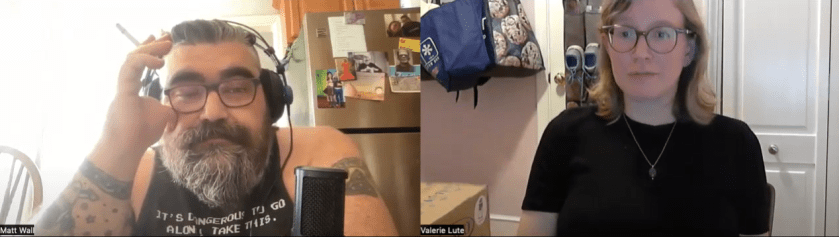
Matt Wall is a punk Renaissance man, working across music, film, poetry, and science fiction. With his do-it-yourself ethos and no-permission-needed approach, Matt embodies the indie spirit. I was inspired by his unique attitude toward creation and publishing, so I asked if he’d share some tips on turning passion into action.

Matt spoke about the raw, unedited nature of his poetry, his goal of expanding his poets’ audiences, and the lessons he learned about releasing fiction on Amazon. Most importantly, he encouraged all you new writers to stop overthinking, start creating, and gave permission to write whatever the hell you want.

Creating Raw Art

You’re a poet and you run a small press, Poetic Anarchy Press. What can you tell a new potential reader about your work, both your own poetry and what your press produces?

I started the press because I couldn’t find stuff I liked to read. I started doing this Poetic Anarchy workshop just in hopes of trying to find people who I liked their shit. And so I was doing the workshops for two years, and then I realized, “Oh shit, there’s a lot of great fucking poets out there.” So I started putting out anthology books on Amazon of the people who came to the workshops. Then I started doing The Blood Rag, which is the one-page broadside, and it just has grown from there. It’s basically very selfish in that the only stuff I put out is stuff that I like to read.

As far as what my stuff is like, it’s really raw snapshot glimpses into things that I’m working through. It’s very therapeutic for me, but I also don’t believe in a lot of editing. I feel like every time you edit you are pulling honesty away from things, and if you do it too much, the soul of the poem disappears, and you just have a bunch of nice-looking lines, but the heart and the blood is gone. I try to do it right the first time.

There is a skill in being in touch with your emotions and having clarity in your thoughts, and even if you’re not editing your poems, the more you do that and try to be clear and express yourself the better the next poem will get.

That’s a good way to look at it. I’ll steal that and use that next time.

I know Charles Bukowski is one of your biggest influences. How has he influenced your writing style? Are there specific poems that you come back to often for inspiration?

Bukowski is a huge influence on me, but I can’t say it would just be him on his own. I do have my own issues with Bukowski. The gonzo observational journalism of Hunter S. Thompson and the cynical satire of Kurt Vonnegut, those things probably are a bigger influence to me than just the poetry of Bukowski. But Bukowski is from here, where I am and he lived on this street where I’m living on now, and he walked these same streets and went to the same shops that I go to every day. So being in the place, walking the walks that other people walked, it makes things more real for me.

As far as a poem goes, he has a poem called “Art.” I’m going to try to say it from memory, and I might fuck this up. “As the spirit wanes, the form appears.” That has always made a huge kick in my balls. If you’re thinking too much about it, your soul isn’t in it. Just think less, write more.

Punk Publishing Ethos

It’s always easier to move a car that’s in drive than it is to move a parked car.

I got interested in chapbooks and zines because I felt like there was a disconnect between my passion for underground music and my literary writing. In the literary world, especially these days, it seems like people value prestige over finding a readership.

Totally, 100%. I don’t know if you’ve heard of SLEERICKETS, but I was on that podcast a while back, and we got into this debate over prestige versus readership or monetary gain. We kept going back and forth on it because the guy who hosts that show, Matthew Buckley Smith, who’s great, but he’s an MFA world guy. He kept talking about how you don’t do anything other than for the prestige. Finally, I’m like, dude, “I can’t fucking pay my rent with prestige, motherfucker. My landlord don’t take it.” He’s great, and we went back and forth, but the idea of prestige to me means less and less because I don’t think most people give a shit. If you were to ask who was the last poet who got a big spread in Poetry, no one would fucking know that except a handful of people who are into that little world, and they probably all know each other anyway. So what the fuck does it matter.

I was wondering, because you started your career in underground music, do you think that influences how you view your poetry and your press?

Yeah, here’s the thing that’s weird. When people say, you have a real punk rock attitude about this, this and that. That’s the only thing I know, so it’s not like I’m like, “I’m going to do this because it’s so fucking punk rock.” It’s just this is how I had to fucking do it. This is how I learned to do things. It has totally shaped everything I do, but it did that out of necessity rather than out of aesthetic purposes. 

I feel like a lot of literary presses do things because of tradition, but what you’re doing is very innovative. I watched your video today, “How to start a book publishing company small press.” You talked about how your job as a publisher is to help your poets expand their audience. Do you think that sets you apart from other small presses?

If it does, I think that’s an indictment of what small presses are. If a small press isn’t trying to build the readership of the people they put out, then what the fuck are they doing? I just don’t know what the end game is. I can’t see what the goal would be. It just doesn’t make any sense. If that’s the case, then that’s sad as shit.

I went to a writing conference this year, and I was at a panel about starting a literary journal and [the editors on the panel] were bragging about not knowing how many readers their online journal had. 

But what’s the brag? “I’m so aloof and apathetic that I don’t fucking give a shit?” Do they just run on grants? Ok, whatever. All this shit is going to dry up, and I don’t know what the fuck they’re going to do. I keep reading how small presses are folding and lit journals are folding, and how the grant money that was there pre-COVID isn’t there anymore. Motherfuckers are fighting to get less money than there was in the first place. But I don’t think they’re fucking fighting because I don’t know if any of them know how to. I feel like if you put them all in a room and put a hurdle in the middle of the room and a sandwich on the other side, and just said, “OK you guys are all going to starve unless you eat that sandwich,” they’ll just be like, “I’m sure someone will come along and hand it to me. I’m not going to fucking climb that hurdle.”

It’s just like, how do you live? I don’t get it. I don’t want to do the whole “how you were raised” bullshit. It’s just a completely different culture that I do not understand and will probably never be accepted into—that’s fine—and it probably won’t even exist in sixty years.

I appreciate how you have a lot of passion for what you’re doing, and you’re being innovative in how you bring art to people. I have a lot of frustrations with [what’s going on] and I always feel like I should be doing more to come up with my own ideas for getting people to care about the written word.

My question to you I guess would be, what is the thing holding you back from trying to figure that out.

I feel like I am trying, it’s just there’s always more that one could be doing.

We can’t ever be super hard on ourselves because if we do that, we’re not going to ever fucking do anything. I’m just always like, “I’m just going to fucking do something.” It’s always easier to move a car that’s in drive than it is to move a parked car. So I’ll just fucking start something, and it will be little, and see what happens. Too many people who want to do something and want to try to change something feel like they need to have the whole fucking thing planned out before they do anything.

When you’re inspired to do something, that’s when you go. Lightning strikes and it flashes. I encourage you to, the second you have an idea to help that shit, just fucking do it.

How to Kill It on Amazon

You mostly write poetry but you do a little fiction too, right?

Because I was making movies and writing screenplays and shit, and then I had all these movies that I still wanted to do, but I was tired of working for producers. This was right around the time that Kindle took off on Amazon, so like 2011, 2012, and I had a TV show pilot that I turned into a serial. I was releasing weekly episodes. That blew up for me. It was nice not writing to a budget. I could do anything I wanted to do. That was so fucking freeing.

I was releasing on a chaotic schedule for the next three years doing novellas, novels, and more serials in all different kinds of genres. It took me a while to realize that doing stuff like that is poison on Amazon. You have to do the same thing over and over again in order for Amazon to want to push you to people. 

That took me all over the place. Probably by 2016, I got back into poetry. That being the thing that got me writing in the first place. I’ve just been doing it ever since because I can do it quickly and I can do any genre stuff I want. I could write about multiple different things in one day and feel like I got a lot done. I’ve written a couple other novels since then too, but it’s mainly the poetry. Lots of short stories too.

As far as my readership goes, my short story chapbooks and collections don’t sell as well as my poetry does. So I tend to put those out less. Still gotta pay the fucking bills, because the landlord still doesn’t take prestige. 

Do you find it constraining to try to write towards the algorithm or is it no different than other artistic constraints when artists are trying to make a living off their work?

Yes, and no. My series that did really well was Black Star Canyon. It had a huge fucking ensemble cast, and it was all different genres. There was a police procedural at the heart of it, but then there was this weird occult thing with some of the characters, and there was this weird sci-fi mad scientist thing with other characters, and there was a love triangle with some other characters.

So how that worked better than all the other shit I’ve done, is that I just took one story, one area, the town, and all these other story ideas I had, all these other books I had, I just took those characters and that story and drop them in that town. And just make that another chapter in the book. If you can do something like that, if you do like to run across a lot of different genres, just try to bring all of that into one series, because series books sell. Amazon pushes series. They’re easy to sell to readers with just the idea if they’ve liked what they’ve read and they get to the end, “continue the adventure by clicking here.” It’s a marketer’s dream. If you can, take every idea you have in your idea folder or post-note drawer, and just keep dropping that shit in.

I’m not going to say it’s going to guarantee success, but you will have much more success doing that.

It seems to me that the characters are what people most connect with, so having recurring characters, even if they just have a cameo appearance, that still engages people.

I will say this, something that will kill your sales faster than anything is killing off characters that people like. You can’t do the fucking Game of Thrones thing. It would have never worked if it came out now. People would have been like “This motherfucker did what? I’m done. One-star review, you fucking piece of shit.”

I killed off a bunch of characters that people liked. It did not go well. So keep thinking I might kind of bring it back. Can I bring them back and do another book? But then I think, that’s just me placating. 

I always liked short self-contained stories, and I guess I’m weird. I know it’s not what most people like.

Honestly, I hate filler, and there are times when you’re reading and know, oh shit, this is some fluff. This is for page count. Goddamnit.

But I think a good short story works the best. That’s what I tell one of my members in the Anarchy Crew, he writes a lot of short horror fiction. He wants to get into novels because he knows short fiction doesn’t sell on Amazon. And I’m like, “Is there any way you can take all your short stories and just take that main character, and now it’s like Bob Jones. And every short story you have is now about Bob Jones. Can you do that?” And he’s like, “Oh, fuck.” And so he’s doing that right now. He’s putting together this big fucking chonker and he’s excited about it. So I hope that that works out for him.

‘Cuz like, back in the day, bind-ups were a huge fucking thing. The Gunslinger, Foundation was a bind-up. Just a bunch of short stories that they were just like, “Oh, I can turn this into a fucking novel.” Dune was a bind-up. All of these little chapters were released in magazines. Then when they realized they could put it together, now they can sell a gajillion copies. 

So everyone go do that. Stop reading this and go do that.

Do you have any new writing projects or collections that you’re working on and do you have anything you’d like to share about those for us?

I still do a monthly chapbook on my Etsy shop, and the one from this month is going to come out at the end of this week. The new Blood Rag will be out this week.

Then I have a couple big poetry collections and a couple big short story collections that I want to do paperback runs of on Amazon.

But I also have a craft book called “Poetry is Bullshit” that I’ve written, but I’m in the process of formatting it. I don’t know why this is taking me so long. Going back and taking all of this shit and snippets from lectures I’ve given, it’s like nails on a chalkboard for me. But I know the shit in it is good. Just know that when it comes out, this was a labor of blood.

Then there’s a documentary being filmed about me right now. That is kind of embarrassing, but it’s also kind of fun. It’s going to do festivals next year. That’s the goal for it. It’s just about how I do things. Embarrassing, but also fun.

When I say it out loud, it does sound overwhelming. Now I need a Xanax. I need to crawl in a hole for a little bit and cry. It’s all good. You have to hustle that shit. No one’s gonna do it for you.

Most people are just looking for permission. If you need someone to do that, I give you my permission. You now have permission to write whatever the fuck you want to write.

You’ve had a lot of advice for new writers, but if there’s one big takeaway, what would that be?

I don’t think I can say just one, so I’ll give a little handful. If there’s anyone out there who thinks, “Why would anyone want to read my stuff? I haven’t done anything, I’m not important, why would anyone want to read it?” If it’s important enough for you to write, that means that there’s an audience for it. It might take you a bit to find that audience, but the fact that you want to do it shows that there’s an interest in it. Don’t worry about that.

The second thing I want to say is: don’t fucking listen to anybody. Just write. Just get your shit out. You don’t have to overthink it. You don’t need anyone else’s approval. You just need to do it if you feel the burning desire inside of you.

Then probably the last thing is, if you want to know how to write: you already know how to write. You already know how to do all this. You send text messages. You send emails. You communicate with people every day. You already know how to do it. Most people are just looking for permission. If you need someone to do that, I give you my permission. You now have permission to write whatever the fuck you want to write.

If you’ve been inspired by Matt like I have, find out more about writing on his website.

Featured
Posted in announcements

New Chapbooks Available

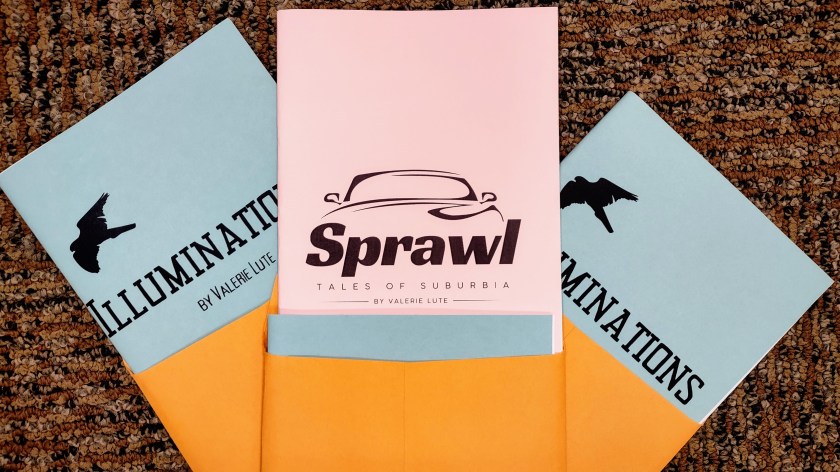
After seeking an artistic way to share my writing with more people, I’ve designed two handmade chapbooks that I’m excited to share with you all. They are now available to buy in my Etsy shop. Each book has a cardstock cover and is printed in small batches. Until the end of October, you can get 25% off when you order both chapbooks. Just use code OPENINGSALE at checkout.

Illuminations: Fantasy Stories by Valerie Lute

Enter the mirror world: whales grow feet and walk into Target, monks without heads perform bizarre rituals, and lovers are trapped in a prison of their own making. In each strange tale, we learn a little bit about our own world.

24 pages, contains two short stories and two prose poems: “A Natural History of Headless Society,” “Singing of Migration,” “Disjoined by Neptune’s Might,” and “Illuminations.”

Read a preview on Liquid Imagination.

Sprawl: Tales of Suburbia by Valerie Lute

Choose a spiral off the expressway, any one will do, into the land where neighborhoods bear names of the topography they replaced…Enter the Sprawl. In these four stories, we meet young people seeking connection and meaning within impersonal landscapes rampant with social inequality and alienation.

24 pages, contains four short stories: “Sprawl,” “Being Here,” “The Storm” and “Tough Guy.”

Read a preview on Literary Orphans.

Take advantage of the launch sale! Until the end of October, get 25% off when you order both books. To claim the discount, use code OPENINGSALE at checkout.

Browse the full collection and get your copies today at ValerieLutePress.

I hope that each of these little books can bring some beauty into your life. Thank you for supporting my writing and small press. Please help spread the word by sharing with fellow book lovers!

Posted in Uncategorized, writing habits

The Pomodoro Technique for Writers: A Productivity Hack for Focus

Staring at a blinking cursor for hours leads to frustration for many writers. Burnout looms over marathon writing sessions. That’s why the pomodoro technique can be a game-changer for writers looking to boost productivity and prevent fatigue.

The pomodoro technique is a time management system that utilizes timed intervals to enhance focus. By writing in short, distraction-free sprints, writers can optimize their energy, attention and motivation.

This article will cover how the pomodoro technique helps writers improve productivity and beat burnout through strategically timed writing sessions. You’ll learn the background of the pomodoro method along with tips to implement it in your writing process. Get ready to maximize your time, creativity and output!

What is the pomodoro technique?

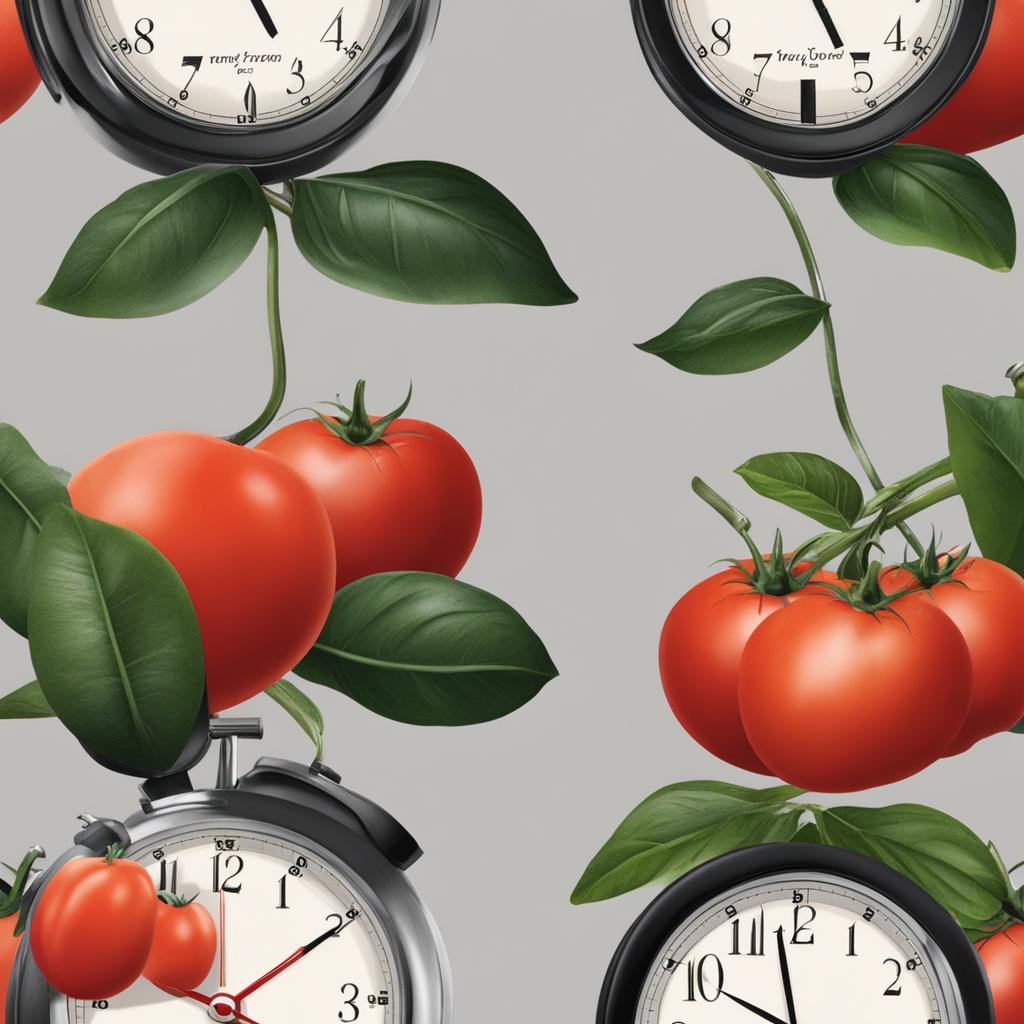
The pomodoro technique is a time management system that breaks work into intervals, usually 25 minutes long, separated by a short five-minute break. Francesco Cirillo first developed the technique in the late 1980s in order to improve productivity and focus. It gets its name from a tomato-shaped egg timer that was popular at the time.

As a university student, Cirillo struggled with staying engaged and productive while studying. He often felt overwhelmed by the amount of material and often procrastinated. To improve his focus, Cirillo decided to break his work into short intervals with breaks in between.

The basic steps are:

  1. Decide on a task to work on. Set a timer for 25 minutes.
  2. Work on the task until the timer rings. Avoid distractions during this time.
  3. When the timer rings, take a 5-minute break.
  4. After taking a break, reset the timer for another 25-minute work session.
  5. After completing 4 work intervals, take a longer 15-20 minute break.
  6. Repeat steps 2-5 until the work is complete.

The forced breaks and time constraints help minimize burnout while maximizing focus. If you’d like, the technique can be customized with longer or shorter work intervals and breaks. Many people find the rhythm helpful for time management and maintaining motivation. You can use any app or physical timers that you already own. I like to use one side of a vinyl record. When the side ends, I get up and do my break before flipping over the album.

What are the benefits of the pomodoro technique for writers?

The pomodoro technique has helped me organize my longer writing projects and get more chores done around the house, as starting laundry and doing the dishes can be a great “break” from writing. I recommend the method to all my students for the following reasons:

  • Increased focus – The timed nature minimizes distractions and keeps you focused on writing for each 25-minute sprint. In a study by the University of Illinois, short breaks were shown to replenish attention and increase productivity.
  • Better time management – By breaking down writing into digestible chunks, you get a sense of how long tasks take. This improves time planning.
  • Preventing burnout – The mandated short breaks act as a safeguard against marathon writing sessions that lead to fatigue and creative burnout.
  • Reduced procrastination – The timer adds accountability and motivation to start writing rather than putting it off. The short timeframe also makes tasks feel more achievable.
  • Improved productivity – Many writers find they complete more daily word count and make greater progress in their work utilizing the focused sprints and time tracking.
  • Finding flow – Having defined writing periods can help writers get into a state of flow where words come easier.
  • Maintaining energy – The cyclic rhythm of intense focus and recovery helps keep energy and motivation high.
  • Opportunities to refill well – The breaks create natural intervals to do quick research, take notes, or stretch your mind with an unrelated task. This has been proven to jog creativity and break writer’s block.
  • Reliable writing routine – Setting timers regularly can establish a productive daily writing habit.

If you are primarily working on a screen, the pomodoro technique provides additional benefits. Taking a screen break reduces eye strain, improves posture and encourages movement – all of which will increase your creativity.

Ready to give the pomodoro technique a try? Here are a few ways you can incorporate it into your next writing session:

How can writers use the pomodoro technique?

  • Use your first timed session for brainstorming. Try using the whole timer period for freewriting, that is writing down everything that comes into your head. If you already have a story idea but are unsure how to get started, use your first timer to jot down all the ideas you have related to your idea.
  • Choose a scene, just one, and write it for the duration of the timer. Having the intention of focusing on a single scene can help clarify your vision. If you choose to set another timer after your first break, you can either continue the scene you are working on or go on the the next scene.
  • Or alternatively, you can use the pomodoro technique to switch between writing and editing. Try not to fix errors or go backward during your writing sessions in order to stay focused on one task at a time.
  • Pair up with a partner or join a writing group. Set a timer together in order to motivate each other and hold each other accountable.

Start timing those writing sprints today to power through projects while preventing burnout. If you are looking for more effective planning hacks for writers, check out my article “6 Time Management Tricks for Writers” and follow this blog on Facebook or Twitter for more tips on reaching your writing goals. Happy writing!

Posted in publishing

What are Literary Journals and Should You Submit to Them?

Getting published for the first time is a major milestone for any writer. Traditionally, emerging writers have gotten their start in literary journals. But what exactly are literary journals, and why should new writers care about them? Literary journals are periodicals focused on publishing fiction, poetry, creative nonfiction, and more from up-and-coming voices.

When I was an MFA student, submitting to literary journals was seen as the gold standard, a rite of passage for newcomers to reach targeted readers, get professional feedback, and begin building publishing credentials. However, changes to the publishing industry may have diminished the role that literary journals once held in expanding a writer’s audience. This guide will walk new writers through everything they need to know about literary journals, from what they are to how to submit.

Defining literary journals

A literary journal is a publication for literature, usually focusing on poetry, short stories, memoir, and literary reviews. In general, literary journals are interested in work that emphasizes language, a character’s internal experiences, and experimental forms. Some major literary journals include The Paris Review, Ploughshares, The Kenyon Review, and ZYZZYVA. You should always sample a literary journal before you submit to see if your work aligns with the editors’ taste.

More characteristics of literary journals:

  • Literary journals provide a platform for writers to get their work published, especially lesser-known writers and new voices.
  • Submissions are competitive, and acceptance rates are low, usually less than 1-5%.
  • Literary journals are independent publications or affiliated with literary organizations, writing programs, or universities rather than large publishing houses.
  • The publishing schedule is typically quarterly, biannually, or annually.
  • Literary journals exist in both print and digital formats. Some publications may do one or the other, some publish both simultaneously, and some have print and digital editions that differ from one another.
  • Writers use literary journals to build their publication credentials and expand their audience.
  • Many prestigious grants, awards and fellowships require applicants to publish work in reputable literary journals.
  • Journals often also sponsor contests, writing workshops, and literary readings.

Advantages and disadvantages of submitting to literary journals

While literary journal publication confers prestige, the process requires patience and perspective. Weighing drawbacks as well as benefits helps set reasonable expectations.

AdvantagesDisadvantages
Status: Publication in an esteemed literary journal can bring immense prestige and credibility.Extremely low acceptance rates: Top journals accept under 1% of submissions. Rejection can be demoralizing.
Exposure: Journals help writers reach targeted readers who are interested in contemporary literature. This audience may have never discovered your work if it was self-published or only on your website.Lack of exposure: Many journals have relatively small print runs and limited audiences. Even online journals generate little traffic.
Incentives: Some journals offer small pay rates, contributor copies, or other incentives.No or minimal payment: Most journals offer little or no monetary compensation beyond complimentary copies. Making money is very unlikely.
Feedback: Some journals provide submission feedback that helps writers improve their work.Slow response times: Journals often take 3-6 months or longer to respond, leaving writers waiting anxiously.
Career advancement: Journal publications help develop a writer’s portfolio and authorial credentials. This can lead to jobs, grants and other benefits.Rights and permissions issues: Journals usually ask for exclusive rights or first serial rights, limiting publishing the piece elsewhere for a period of time.
Community: Connecting with editors and fellow contributors can foster a literary community.Genre constraints: Journals focus on literary fiction, poetry and creative nonfiction. Other genres like fantasy, horror or children’s literature may be marginalized.
To improve editing skills: Editing work for publication teaches writers valuable skills in self-editing.Subjective selection: Editors’ individual tastes heavily influence acceptance, so submissions may be passed over despite merit.
Contests: Journals often sponsor contests with attractive prizes, including generous payments and publication.Submission Fees: In the past decade, it has become normal for journals to charge $2-3 to read a submission. Because of low acceptance rates, these fees can add up.

While publication is very competitive, submitting to quality journals can enrich a writer’s craft, reputation, network, and audience if persistence and care is taken in identifying the right opportunities.

How have literary journals changed?

In recent years, the literary journal landscape has shifted in some important ways that aspiring contributors should understand. Our 21st century digital landscape has changed the way readers find what’s exciting to them. Here are a few of the ways Literary journals have adapted to try to keep up with our rapidly evolving world.

  • Increased online presence: While print journals continue to publish, most also have websites, blogs, social media accounts, and digital subscription options.
  • Rising submission volume: Because digital submissions through online systems like Submittable have removed postage barriers, more writers than ever are submitting their stories. Since acceptance rates remain very selective, this means writers get more rejections than ever.
  • Predatory journals: Some fraudulent online journals charge submission fees but lack rigorous editorial standards or audience engagement. Writers must vet journals carefully before paying any fees.
  • More contests and awards: Journals are using contests, fellowships, and awards to generate revenue and promotion.
  • Multimedia integration: With online content, journals can now include audio, video, graphic art, and even interactive elements alongside traditional text.
  • Wider genre diversity: While most literary journals remain uninterested in hard sci-fi or fantasy, more journals are open crossover work that combines elements of genre and literary fiction.
  • Increased diversity: Following wider publishing trends, journals are making incremental progress in publishing more women, people of color, and LGBTQ+ writers.
  • More public events: Literary journals host live readings, panels, and conferences to build community and connections beyond the printed page.

While rising costs and competition create challenges, these changes allow literary journals to stay vital and engage broader audiences. The core mission of publishing emerging voices endures.

What about submission fees?

One significant change to literary journal submissions is the growing prevalence of submission fees, which all writers should be aware of. A submission fee is a charge required to submit written work to a literary magazine or journal for consideration for publication. They are typically between $2-$5 for prose or poetry submissions, though some journals charge up to $25.

These fees were once a rarity in the literary world, but in the past decade they have become ubiquitous. If you’re planning on sending your fiction, poetry or personal essay to a literary journal, it’s imperative that you understand what submissions fees are and how to determine if they are worth the cost. In my post “Should You Pay A Submission Fee?” I explore all the questions you should ask before coughing up your hard-earned cash. 

Who shouldn’t submit to literary journals?

My biggest tip is to wait until you have a strong grasp of craft, publication options, and the persistence required to withstand the submission process. Don’t rush out underdeveloped work. This will only waste your time and the editors’.

  • Complete novices: Writers who are just starting out usually benefit more from joining workshops, classes, or writers’ groups to develop their craft before trying to get published.
  • Genre writers: Most literary journals do not accept fantasy, science fiction, mystery, horror or thriller. There are genre-specific magazines which are better suited for those writers.
  • Children’s writers: Specialized children’s lit journals or magazines are better avenues for children’s literature and YA.
  • Non-literary writers: Those writing speeches, self-help books, essays for mass audiences often find better homes elsewhere.
  • Writers focused on book publication: If your goal is to publish a novel or book length memoir, literary journals may not be the best use of your time and energy.
  • Writers who haven’t thoroughly revised work or considered a piece’s audience: Take the time to polish a manuscript and carefully match submissions to each journal’s editorial guidelines and style preferences.
  • Writers impatient for quick acceptance: Publishing with literary journals is a slow process requiring persistence through many rejections.
  • Writers unwilling to follow guidelines: Editors will dismiss submissions that don’t follow their requirements.

While literary journals have broad scope, writers need to carefully evaluate if their specific work and publication goals truly align with submitting to journals versus other options.

How do you find literary journals?

Once you’ve determined that literary journals are a good fit for your goals, the next step is identifying the right publications and doing your research. There are thousands of literary journals, big and small out there. It can be overwhelming to sift through them all to find the right home for your work. These are the steps I would recommend to start your submission process.

  • Start by searching literary journal databases like Duotrope, Submittable Discover or New Pages to find journals accepting submissions in your genre.
  • Consult literary journal ranking lists like BookFox Top 100 Literary Magazines to find acclaimed journals in your genre.
  • Browse journal listings in Poets & Writers magazine or the annual Writer’s Market book.
  • Attend literary conferences, readings, or workshops and collect issues of journals of interest.
  • Follow literary journal websites, blogs, social media for submission period announcements. Sign up for newsletters.
  • Network with other writers, teachers, editors to hear recommendations from people who understand your writing style.
  • Research the acknowledgments of books you admire to see where excerpts or stories were published.
  • Search bookstores or libraries for literary journal back issues to peruse.
  • Keep it local: look for journals affiliated with nearby writing programs or regional arts councils.
  • Read journals extensively to get to know their unique personalities and aesthetics.
  • Focus on journals publishing work similar in style, genre, and voice to yours.

With so many journals to comb through, using multiple resources and doing thorough research is key to creating a targeted, effective submission list.

Literary journals I collected at a writing conference.

Ready to submit?

After you’ve built out a list of potential journals, here are some tips to evaluate when your work is actually ready for submission. Here are some tips on when a new writer should consider submitting their work to literary journals:

  • After developing strong writing fundamentals: Before submitting, new writers need practice honing their craft through workshops, classes, or informal critique groups to build skill in elements like dialogue, description, structure, and plot.
  • After producing multiple completed, polished pieces: Having a few strong options allows picking the best piece for a particular journal’s guidelines and editorial taste, and it provides fallback options if one is rejected. Some journals will encourage you to submit again if the rejection was a close call.
  • After thorough revision: Pieces should go through multiple rounds of editing, with feedback from others if possible, before being sent out. Resist submitting first drafts.
  • After researching target journals: Take time to read sample issues of journals, understand their aesthetic and voice, and ensure they accept new writer submissions.
  • When mentally prepared for rejection: Develop resilience since all writers will face some rejection. Don’t let it discourage you from continuing to submit.
  • After developing a submissions strategy: There are a lot of literary journals out there, so it helps to be organized. Keep track of all submissions to make the process efficient and track responses.

While publication in literary journals is no guarantee of fame or fortune, there are potential rewards for writers open to slowly building a career path. Eyes on your work, even if limited, creates a small but engaged audience. And persistence through the competitive slush pile can gradually lead to more milestones, whether it be a Pushcart nomination, residency fellowship, or simply carving out your niche among like-minded voices.

Ultimately the effort required comes down to personal priorities and patience. Literary journals are not the only valid route for writers, but for some it provides community, discipline and incentive to keep creating amidst isolation and rejection. Don’t buy into hype or false promises, but if you find satisfaction in the process itself, then keep faith and let each story find its readers. Keep writing, keep growing, and find communities that nurture, not limit, your voice. If you’d like to join my writing community, subscribe to the blog or follow me on Facebook and Twitter.